

Our Story
Stand in Mali Zalazi and you feel connected to the sea and the sky at the same time. That is what mountain tops do. That is what this one has always done.
Our fathers were born here, 820 metres up on the Vrmac ridge, in a village where families shared everything and looked out for one another as a matter of course. The women worked as hard as anyone, harder than most. They made dairy, carried it down the long mountain path to the sea to sell, and climbed back up again. Not because they had to. Because that was life, and life here was something worth showing up for.
The Place
The stone still remembers them. A house with 1898 cut into the lintel. A threshing floor marked 1921, where wheat was beaten out and, on feast days, people danced. A fountain built in 1930, still the first thing you reach after the climb. The Pejanović name travels further than the village itself. It appears on passenger lists from Cattaro, the old name for Kotor, on ships bound for New York.
Then the diaspora came, and the village emptied, and the path the women walked grew over, and St. Jovan's church stood alone in the courtyard for nearly a hundred years.
But here is the thing about Mali Zalazi. It never stopped feeling like home.
Not to our fathers, who carried it with them across oceans and described it at dinner tables as though they had left yesterday. Not to us, their children, who grew up belonging to a place we had never been. And not when we finally came back, and stood in that courtyard, and looked out over the Bay of Kotor, and understood, without needing to say it, exactly why no one who was ever from here truly got over leaving.
The village sits within the UNESCO World Heritage buffer zone of the Natural and Culturo-Historical Region of Kotor. Locally, it has another name. Zalaz is the Montenegrin word for sunset. To the people who know it, this is simply the village of sunsets.
Why we are returning
This village deserves to be celebrated. Not preserved behind glass, not frozen in time, but brought back to life. The same stone, the same hands, the same spirit, with the sun powering what candles once did.
That is what we are doing, slowly and with great love. For the women who walked down to the sea. For the families who made something remarkable out of very little. And for everyone who has ever stood on a mountain top and felt, just for a moment, that they were home.
If that is you, we hope you will be part of it. Read about the plan or help us build it.

The People Behind the Project
Mali Zalazi is led by Marina Cvetković and Carolina Pejanović.
Marina and Carolina bring a rare combination of curatorial knowledge and commercial understanding to Mali Zalazi. One guards what the village was. The other builds what it can become. Together, they make sure the project is both culturally grounded and built for the long term.
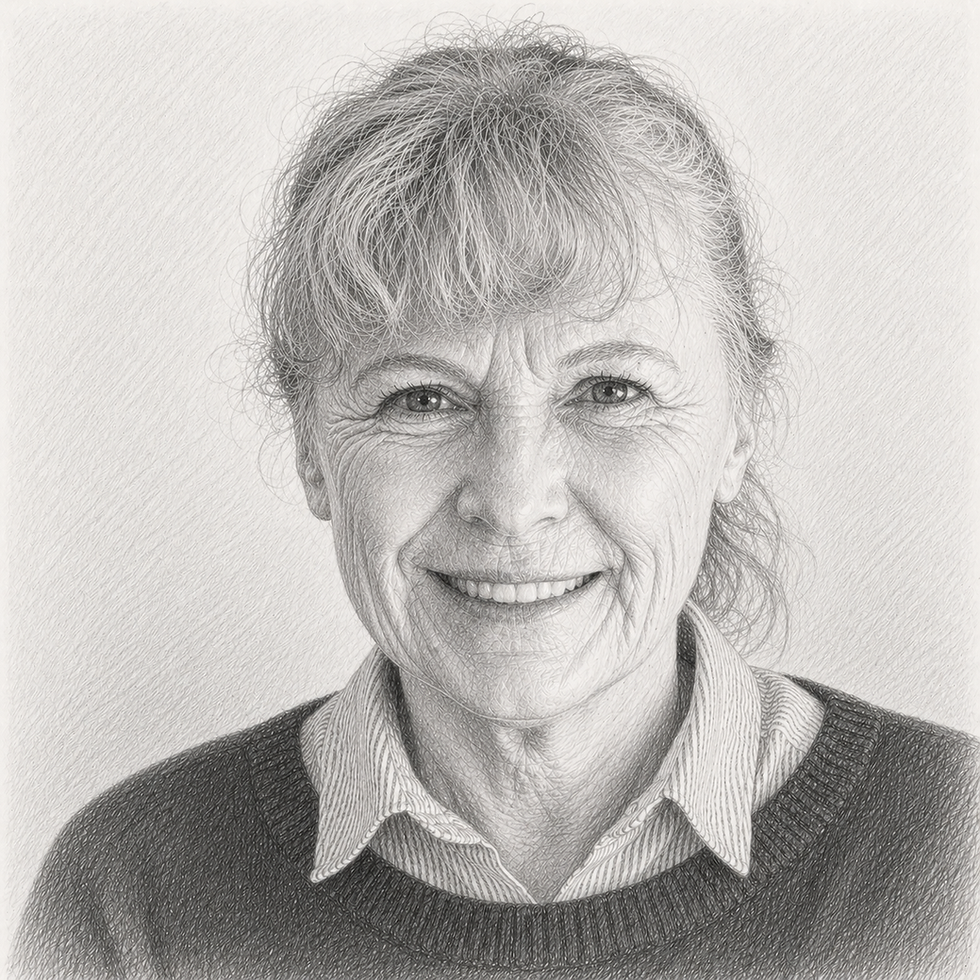
Marina Cvetković
Marina is a senior museum curator based in Belgrade, specialising in textile heritage and the tradition of Balkan tapestry. Her work takes her around the world, where she lectures, exhibits and teaches, introducing international audiences to an art form that has carried the region's history in thread for centuries.
At Mali Zalazi, Marina leads the heritage and conservation of the project. Every decision about what we keep, what we rebuild, and what this village becomes, is shaped by her curatorial eye and her deep understanding of how a place like this should be brought back to life without losing what made it worth saving in the first place.

Carolina Pejanović
Carolina is an entrepreneur who splits her time between London and New York. Her father was born in Mali Zalazi, one of the Pejanović names that immigrated to New York in the 1960s. For her, this project is both a return and a responsibility.
She leads the strategy, fundraising and long-term development of the foundation, drawing on a career of building and growing ventures. Her role is to make sure that what Marina is restoring can sustain itself for the next hundred years.
So that the village never empties again.
